
Last updated October 16, 2026
 Water damage drying
 Fire & smoke cleanup
 Mold remediation
 Storm response
 Sewage cleanup
 Reconstruction
Free visual inspection and a written scope of work before any mitigation begins - photos, moisture readings, and drying logs go in your claim file
The scope we write is the scope we bill. Anything new gets shown to you, in writing, before we touch it.
Get your free estimateDamage Restoration Cost Breakdown: The San Diego Homeowner’s Reference for 2026
San Diego water restoration jobs run 15 to 25 percent above the national average, and most homeowners never find out why until the invoice arrives. The culprit isn’t gouging, at least not usually. It’s a mix of California labor rates, Miramar Landfill dump fees, asbestos testing on older homes, and the licensing structure that makes unlicensed underbidding both common and risky. The restoration industry also has a pricing habit that makes comparison shopping nearly impossible: quoting “per affected square foot” without ever defining what affected means. That number swells between the first walk-through and the final bill if the scope isn’t locked in writing. This guide breaks down the actual line items on a San Diego restoration estimate, what each should cost in 2026, and how to read a contractor’s invoice so you’re signing something you understand instead of something you hope is fair. For Damage Restoration Warning Signs: A San Diego Homeowner’s Reference Guide, see our companion post. We’ll walk through extraction, drying equipment, antimicrobial treatment, demolition, rebuild, and the insurance mechanics that determine your actual out-of-pocket number.
Restoration work we handle
Quick Answer
Water damage restoration in San Diego typically costs $3.75 to $7.50 per affected square foot in 2026, with most single-room jobs landing between $2,800 and $6,400 before rebuild work. A full mitigation plus rebuild for a kitchen or bathroom water event usually runs $8,000 to $18,000 depending on cabinetry, flooring, and the age of the home. The single biggest factor in your final price is whether you lock a written scope of work before demolition starts, because that’s the document that prevents the “affected area” from quietly growing.
Table of Contents
- The 2026 Line-Item Breakdown: What Every Phase Costs in San Diego
- Insurance Math: Actual Cash Value vs. Replacement Cost Value
- The Line Items Nobody Warns You About
- How to Read Equipment Rental Markups Without Getting Padded
- Why Three Estimates Fails After Water Damage (And What to Do Instead)
- The Scope-of-Work Document: Your Best Negotiation Tool
- Common Mistakes to Avoid
- When to Call a Professional
- Frequently Asked Questions
- The Bottom Line
The 2026 Line-Item Breakdown: What Every Phase Costs in San Diego
A restoration invoice in San Diego breaks into five phases: extraction, drying, antimicrobial treatment, demolition, and rebuild. Each carries its own labor rate, equipment cost, and disposal fees, and each gets marked up differently depending on the contractor. Here’s what you should expect to see in 2026.
Phase 1: Water Extraction
Extraction is the first response: removing standing water with truck-mounted or portable extraction units. In San Diego, extraction labor runs $75 to $145 per hour, and a typical single-room extraction takes 2 to 4 hours, not 12. The line item on your invoice will likely read something like “Category 2 water extraction” or “Class 2 water extraction,” which refers to the IICRC classification of water contamination level and evaporation rate. Category 1 is clean water from a supply line, Category 2 has some contamination from a washing machine overflow or shower backup, and Category 3 is sewage or flood water. Class refers to how fast the water is evaporating from materials, which dictates how many air movers are needed.
What extraction should cost: $350 to $700 for a single room, $1,200 to $3,000 for multiple rooms or a whole floor. If the standing water has been sitting more than 24 hours, expect the higher end because saturated materials require more passes and the water has likely wicked into drywall and baseboards.
Phase 2: Structural Drying
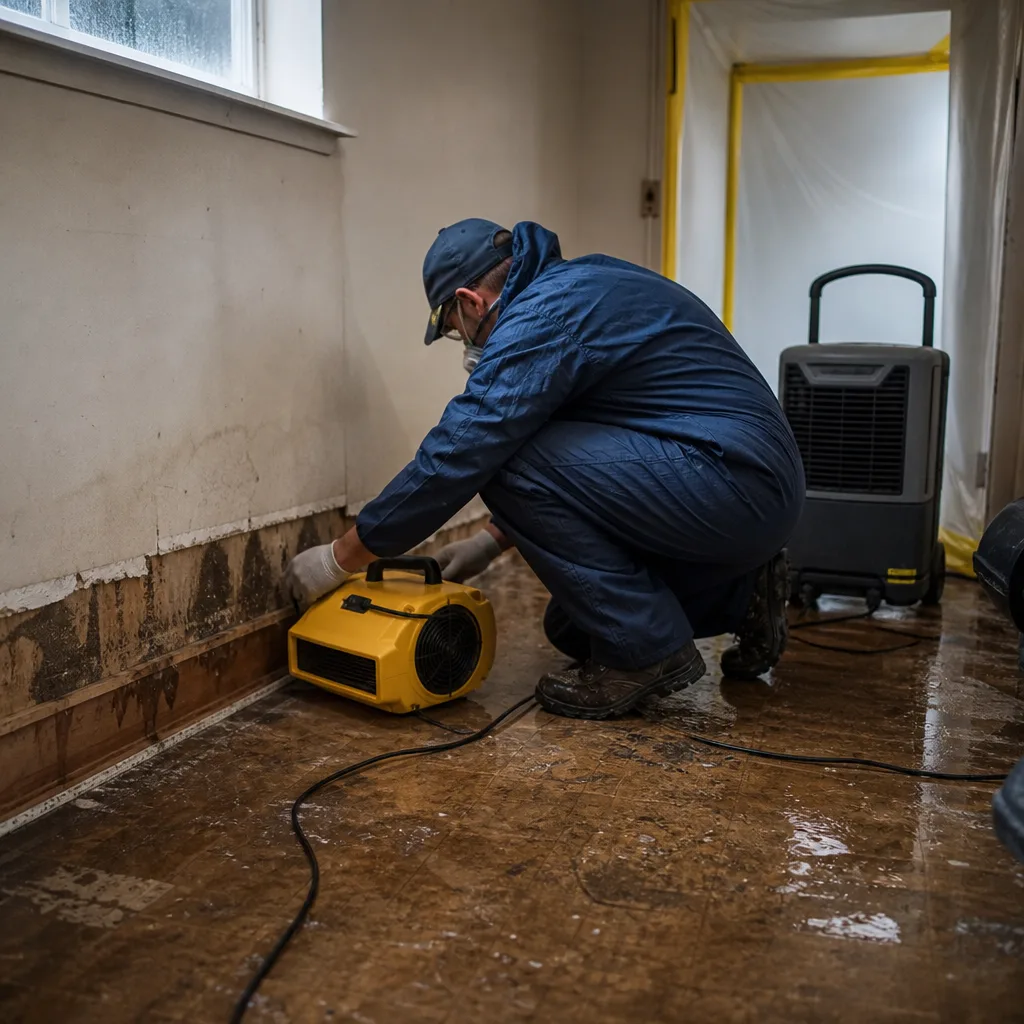
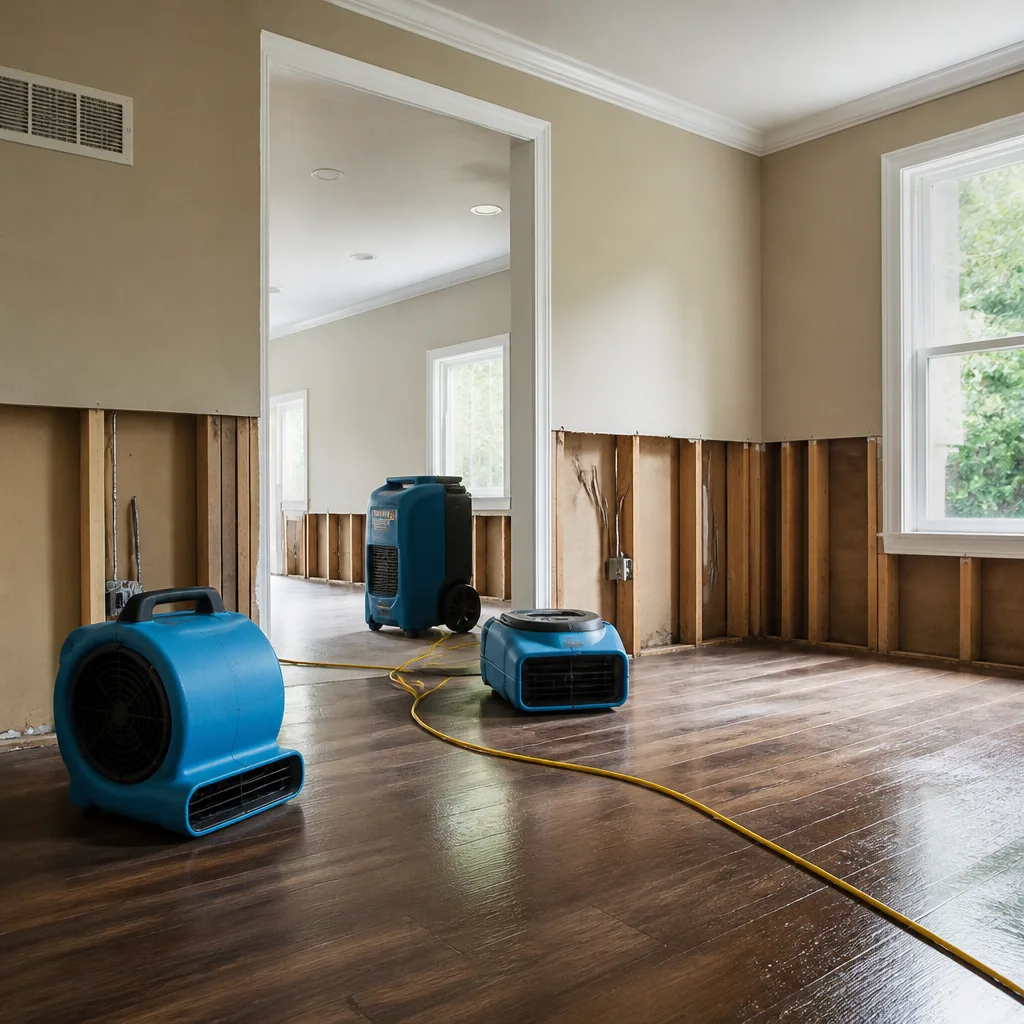
This is the phase where San Diego homeowners see the widest price swings. Structural drying means running industrial dehumidifiers and air movers for 3 to 6 days, pulling moisture out of drywall, framing, subfloor, and any trapped cavities. The process is called psychrometric drying, which simply means we track temperature, humidity, and moisture content daily so we know when your home is truly dry, not just dry to the touch. A proper drying log records moisture readings at the start, 24-hour increments, and the final day, and it’s a document you should request. Companies that skip the log are guessing, and guessing means either under-drying (mold risk) or over-billing on days you didn’t need.
Daily equipment rates in San Diego run $55 to $90 per dehumidifier per day and $35 to $60 per air mover per day. A single room typically needs 1 dehumidifier and 4 to 6 air movers, which puts daily drying at $195 to $450 per room per day. Over a 4-day dry, that’s $780 to $1,800 in equipment alone, plus daily monitoring visits at $85 to $150 per visit. Add $350 to $600 total for moisture mapping and documentation. Brands matter here: we run Dri-Eaz and Phoenix equipment almost exclusively because their low-grain refrigerant dehumidifiers pull water faster than contractor-grade big-box units, which shortens total drying days, and that’s usually where a San Diego homeowner recovers the cost of hiring a company with commercial equipment.
Phase 3: Antimicrobial Treatment
After drying, surfaces get an antimicrobial treatment to prevent mold from taking hold in materials that were wet for any significant time. In San Diego’s coastal humidity, particularly in neighborhoods like Point Loma, Ocean Beach, and La Jolla where ambient moisture never really drops, this step is not optional. The product is applied to framing, studs, and the backside of drywall before closing things up.
Expect $1.50 to $3.00 per square foot of treated area. For a 200-square-foot room, that’s $300 to $600. Some contractors skip this line item entirely and rely on drying alone. If you’re in a humid microclimate or the water sat for more than 48 hours, that’s a risk you don’t want to take. Ask explicitly whether antimicrobial is included, and if it’s not, ask why.
Phase 4: Demolition and Removal
Drywall that’s been saturated wicks water upward and outward. The rule of thumb is to cut 12 to 24 inches above the visible water line, because capillary action pulls water higher than what’s visibly wet. Baseboards, insulation, and sometimes flooring come out too depending on saturation. Demolition labor in San Diego runs $55 to $95 per hour, and a single room of drywall removal, baseboard, and flooring usually takes 1 to 2 days with a 2-person crew.
For a standard 10×12 room: drywall removal and disposal runs $900 to $1,800, baseboard removal $150 to $400, flooring removal $400 to $1,200 depending on material (tile is pricier to demo than laminate). Total demolition for one room: $1,500 to $3,400.
Phase 5: Rebuild
Rebuild is a different trade with a different pricing structure. Drywall replacement, texture match, painting, baseboards, and flooring installation typically run 2 to 3 times the demolition cost. San Diego rebuild rates for a single room in 2026:
- Drywall replacement and finish: $2.50 to $4.50 per square foot installed
- Paint (including primer, two coats): $400 to $900 for a single room
- Baseboards: $3 to $6 per linear foot installed
- LVP or laminate flooring: $6 to $10 per square foot installed
- Tile flooring: $12 to $20 per square foot installed
A full rebuild on a 200-square-foot room with mid-range materials lands between $3,500 and $6,500. Add cabinetry and countertops for kitchens, and you’re in the $8,000 to $15,000 range without blinking.
Insurance Math: Actual Cash Value vs. Replacement Cost Value
Two identical water damage events in the same San Diego neighborhood can produce wildly different out-of-pocket costs depending on which policy type the homeowner holds. The difference is depreciation, and it’s worth understanding before you ever file a claim.
Replacement cost value (RCV) pays what it costs to replace damaged materials with new materials of like kind and quality, with no deduction for age. If your 8-year-old laminate floor gets destroyed, RCV pays for new laminate.
Actual cash value (ACV) pays replacement cost minus depreciation, which is calculated based on material age and expected lifespan. An 8-year-old laminate floor with a 20-year lifespan has depreciated 40%, so ACV pays 60% of the replacement cost. The homeowner covers the rest.
Here’s a concrete San Diego example. A water heater fails in a Rancho Bernardo home and floods a 200-square-foot living room with 8-year-old engineered hardwood flooring. The replacement quote for flooring comes in at $2,800 installed. Under an RCV policy, the carrier pays $2,800 minus deductible. Under ACV, the carrier calculates $2,800 minus 40% depreciation, or $1,680, then subtracts the deductible. The homeowner is out of pocket an extra $1,120 for the exact same damage event.
The same depreciation logic applies to drywall, paint, baseboards, and even some labor categories on older homes. Pre-1980 homes in San Diego neighborhoods like Normal Heights, North Park, and parts of Chula Vista add another layer: asbestos testing on drywall compound that predates the 1980 ban. See Damage Restoration Permits, Codes & Inspections in CA: What You Need to Know for full regulatory details. If the test comes back positive, removal requires a licensed asbestos abatement contractor, which adds $1,500 to $4,000 to a single room and can take an extra 3 to 5 days. Your restoration company should coordinate testing before any demolition starts, not after drywall is on the floor. We do this on every pre-1980 San Diego job as standard practice, because finding out mid-demo is how small claims become large ones.
The Line Items Nobody Warns You About
Every San Diego restoration invoice includes charges most homeowners have never heard of. Here are the specific line items that show up on local invoices and what they should cost.
Dump Fees at Miramar Landfill
Debris from a San Diego water damage job goes to Miramar Landfill, and the gate fees are real. Current tipping fees at Miramar run $70 to $110 per ton for construction and demolition debris, and the cost rolls directly into your invoice as a line item or embedded in the demolition rate. A single room of drywall, flooring, and baseboards produces 300 to 800 pounds of debris, so you’re looking at $15 to $45 in raw dump fees per room. Contractors add a hauling charge for the trip, which brings the line item to $150 to $350 per load. If you see a dump fee line item above $500 on a single room, ask for a breakdown.
Content Manipulation Charges
“Content manipulation” is restoration industry language for moving your furniture and belongings so work can proceed. It includes packing out affected rooms, wrapping contents in plastic or moving them to an unaffected area, and sometimes off-site storage. San Diego rates run $75 to $150 per hour for a 2-person pack-out crew, and a typical 3-bedroom job involves 4 to 8 hours of manipulation. Off-site storage at a climate-controlled facility adds $150 to $400 per month depending on volume. This line item catches homeowners off guard because it’s rarely discussed before work begins.
After-Hours and Emergency Call-Out Fees
Water damage does not respect business hours, and neither do San Diego restoration companies’ costs. A 2 a.m. call-out for a burst supply line in a Clairemont condo will include an emergency dispatch fee of $150 to $350, plus after-hours labor rates that run 1.5 to 2 times the standard rate. If you catch the water event during business hours, you avoid the surcharge. The trade-off: waiting until morning often means more saturation, more demolition, and a larger overall claim. In most cases, the emergency fee is the cheaper path.
Asbestos Testing on Pre-1980 Homes
As mentioned above, but worth stating as its own line item: pre-1980 homes in San Diego likely have asbestos in drywall compound, flooring adhesive, or popcorn texture. Testing runs $250 to $600 per sample site, and most restoration jobs require 2 to 4 sample locations. If results are positive, abatement adds $1,500 to $4,000 per room and delays work by several days. This is a California-specific regulatory reality that most national cost guides never mention.
How to Read Equipment Rental Markups Without Getting Padded
A restoration company rents commercial drying equipment and marks it up. That’s not a secret and it’s not inherently dishonest; the company is carrying the logistics, deployment, retrieval, and maintenance costs. But the markup range is wide, and knowing what’s reasonable protects you from what isn’t.
Here’s what the equipment actually costs a restoration company to own and operate per day, amortized across its lifespan:
- Low-grain refrigerant dehumidifier (Dri-Eaz or Phoenix): $12 to $18 per day true cost
- Air mover (high-velocity axial fan): $3 to $6 per day true cost
- HEPA air scrubber (XPOWER or B-Air): $10 to $15 per day true cost
What shows up on your invoice should be roughly 2 to 3 times those numbers. So a dehumidifier at $55 to $90 per day, an air mover at $35 to $60 per day, and an air scrubber at $45 to $75 per day are all within a fair range. When you see dehumidifiers billed at $175 per day or air movers at $95 per day, the contractor is padding the equipment line to make the labor line look smaller. That’s a common tactic in San Diego because homeowners comparison-shop on labor rates and rarely question equipment.
Here’s the more important question: how many pieces of equipment are actually in your home, and how do you verify it? A written equipment schedule should be part of your scope document. It lists every unit by type and serial number, shows placement locations, and commits to daily monitoring. If the invoice says 12 air movers and you counted 7 in your photos, you have a billing dispute. The fix is simple: ask for the equipment schedule in writing before drying starts, and request daily photo documentation. We take before-and-after photos by text as standard practice, and every piece of equipment we deploy gets logged with its serial number so the invoice matches reality. If a contractor won’t put the equipment schedule in writing, walk away.
Why Three Estimates Fails After Water Damage (And What to Do Instead)
Conventional wisdom says get three quotes before any home project. For water damage restoration in San Diego, that advice falls apart fast-read our DIY vs Professional Damage Restoration: The San Diego Homeowner’s Decision Guide for related context. Here’s why.
First, water damage is an emergency. Standing water is actively destroying drywall, flooring, and framing while you’re scheduling walk-throughs. You don’t have a week to get estimates. You have hours.
Second, three different contractors will produce three different scopes. One might recommend drying in place. Another might recommend cutting drywall 2 feet up. A third might recommend gutting the entire room. The quotes aren’t comparable because the work isn’t comparable. You’re not choosing between apples and apples. You’re choosing between an apple, a squash, and a floor lamp.
Third, some San Diego restoration companies use the free estimate as a sales call. The initial number is deliberately low to get you to sign, and then supplemental charges appear as the job progresses. The free estimate wasn’t a price; it was a foot in the door.
What to do instead:
- Get one detailed written scope from a company whose process you trust, and get it before any work starts. The scope should list every room affected, the square footage of each affected area, the exact work to be performed in each room, the equipment schedule, and the total price. At Wendell Water Damage Restoration, we put the price in writing before any work starts, and the number on that document is the number you pay. Not an estimate, not a range, not “subject to change.”
- Ask for daily photo updates. Before-and-after photos by text let you verify the work is actually happening as described. If a contractor bristles at this request, that’s information.
- Confirm who is doing the actual work. Some San Diego restoration companies sell the job and then subcontract the labor. Ask whether the crew is in-house or subcontracted, and whether they’re background-checked and uniformed. You should know exactly who is walking through your door before they arrive.
The Scope-of-Work Document: Your Best Negotiation Tool
The single most valuable document in a San Diego water damage restoration job is the written scope of work. This is the line-by-line description of what will be done, where it will be done, and what it will cost. A real scope document is specific. It names rooms. It specifies the linear feet of baseboard being removed. It says “remove and replace drywall in living room north wall, 14 linear feet, cut to 24 inches above finished floor.” It lists the equipment, the daily monitoring schedule, and the antimicrobial products being applied.
Here’s what a strong scope of work includes:
- Property address and job date
- Insurance company and claim number (if applicable)
- Rooms included and excluded
- Square footage of affected area per room
- Demolition plan with cut lines specified
- Equipment schedule (type, quantity, serial numbers, placement)
- Antimicrobial products and application areas
- Drying goals and monitoring schedule
- Rebuild scope and material allowances
- Total price, payment schedule, and guarantee terms
If the contractor hands you a one-page document with a lump sum and no detail, that’s not a scope; it’s an invitation to a billing argument. The moment you have a written scope, you can compare proposals from different contractors by placing them side by side and seeing where one includes work another omitted. That’s the comparison that matters, not a bottom-line number with no line items behind it. And if a contractor refuses to provide a written scope, that’s the clearest signal in the entire industry that you’re dealing with someone who wants the number to move.
Our Water Damage Restoration in San Diego work always starts with a written scope. It’s the same document we use for Water Damage Repair in San Diego jobs and every Mold Remediation in San Diego project. One standard, one document, no surprises.
Common Mistakes to Avoid
- Signing without a written scope. This is how a $3,500 single-room extraction becomes an $11,000 full-floor gut. If the contractor won’t put the scope in writing before starting, do not let them start.
- Accepting “we’ll dry it in place” without moisture readings. Drying in place is legitimate in some cases, but only if the contractor is taking psychrometric readings daily and documenting drying progress. No readings means no accountability.
- Skipping antimicrobial treatment to save $300. In San Diego’s coastal humidity, especially west of I-5, an untreated wall cavity is a mold farm waiting for spores. The $300 you save becomes a $4,000 mold remediation bill in six months.
- Not filing the insurance claim the same day. California sets no statutory deadline for water damage claims, but policies typically require prompt reporting. Delayed reporting gives the carrier an opening to question whether the damage got worse due to your inaction.
- Letting the restoration company bill the insurance company directly without documenting the work. Direct billing is convenient, but you should still see every invoice and receive photo documentation. You’re the one who signed the policy; you’re the financially responsible party on the claim.
- Paying a large deposit before work starts. San Diego restoration companies that are established and insured typically don’t require more than 10 to 20 percent down. A 50 percent deposit demand is a red flag. On our jobs, the price is in writing and the digital invoice is texted with a link to pay. The number on the screen is the number you pay, and it doesn’t move.
- Choosing the cheapest bid to satisfy a nervous insurance adjuster. The adjuster wants the claim closed at the lowest reasonable cost. You want your home restored properly. These are not the same goal. A low bid that under-scopes the drying is how you end up with mold behind walls that showed as “dry” on the report.
When to Call a Professional
Any water event that soaks drywall, flooring, or insulation beyond what a wet-vac can pull in an hour is a professional restoration call, and San Diego’s climate makes fast drying non-negotiable. Standing water in contact with drywall for more than 24 hours is already beginning to wick upward. If the water is Category 2 or 3 (washing machine overflow, sewage backup, toilet overflow beyond clean supply water), do not attempt DIY extraction. The contamination requires antimicrobial treatment and protective equipment. If you’re in a pre-1980 San Diego home, demolition work may require asbestos testing before anything comes out, and that’s a regulatory process a licensed restoration company handles in coordination with the lab. Wendell Restoration San Diego offers free estimates in San Diego, call (858) 988-6639 and a live person answers 24/7. Water damage does not keep business hours, and neither do we.
Frequently Asked Questions
Water damage restoration in San Diego runs $3.75 to $7.50 per affected square foot for mitigation (extraction, drying, antimicrobial treatment, and demolition), with rebuild work adding another $2.50 to $4.50 per square foot for drywall and finish, plus flooring materials and labor. A written scope of work is the only way to know your actual square footage and total price before work starts. Call (858) 988-6639 for an exact quote on your specific situation, estimates are free.
Homeowners insurance covers water damage restoration when the cause is sudden and accidental, such as a burst supply line, a failed water heater, or a washing machine hose rupture. It does not cover gradual leaks, seepage, or flood damage from rising water, which requires separate flood insurance. Your out-of-pocket cost depends on whether your policy pays replacement cost value or actual cash value. Photo documentation of all damage and the drying process is essential for claim approval, which is why before-and-after photos by text are included on every Wendell job.
A restoration company with 24/7 live dispatch can have a technician on-site within 60 to 90 minutes in most San Diego neighborhoods, including the coastal communities and inland areas. Speed matters because drywall begins wicking water within hours and mold colonization can start within 24 to 48 hours in San Diego’s climate. Call (858) 988-6639 and you’ll speak with a live person who can dispatch a technician with a live arrival time you can track, not a vague four-hour window.
It depends on the water category, saturation level, and how long materials stayed wet. Clean supply water that’s extracted within a few hours and properly dried may not require full remediation. Category 2 or 3 water, or any water that sat for more than 48 hours, almost always requires demolition of saturated materials and antimicrobial treatment. A reputable restoration company will tell you which scenario you’re in and put the recommendation in writing before any work starts.
A full-service restoration company coordinates directly with your insurance adjuster, providing the moisture readings, drying logs, photo documentation, and itemized scope of work that the adjuster needs to process the claim. You should still expect to see every invoice and every document the contractor sends to the carrier. Direct adjuster coordination is standard on every Wendell Restoration San Diego home job, which is how we keep claims moving without leaving you as a middleman.
San Diego restoration costs run 15 to 25 percent above national averages due to three factors: California labor rates for licensed technicians, Miramar Landfill tipping fees that roll into every demolition job, and the regulatory overlay that requires asbestos testing on pre-1980 homes before demolition. Add coastal humidity that demands more aggressive drying protocols, and the premium is structural, not opportunistic. A written scope with itemized line items lets you see exactly where your money is going rather than wondering about it after the invoice arrives.
The Bottom Line
San Diego water damage restoration costs more than the national average, and the only way to know whether you’re paying a fair premium rather than being overcharged is to see every line item in writing before work starts. The written scope of work is the document that locks the “affected area,” the equipment schedule, the antimicrobial treatment, and the total price. Insurance policy language (RCV versus ACV) determines your actual out-of-pocket number. San Diego’s unique cost drivers (labor rates, Miramar Landfill fees, asbestos testing on older homes, coastal humidity) are real and explainable, not mysterious. When you understand the invoice, you can sign it with confidence. Browse our more guides & resources, or call (858) 988-6639 for a free estimate-day or night, a live person will answer.
Written by Blake Sorensen, Owner at Wendell Restoration San Diego, serving San Diego since 2006.
See the difference
 Before
 After
After Before
 After
After Before
 After
After